

August 2026
NOSYUDO SHINSAKUTO NIHONTO (Shinken Mei)
Introduction:
This is the first Shinsakuto Nihonto (newly made authentic Japanese sword) I have owned, and my first foray into Kantei (apprisal) and further research a blade’s province.
There is a depth to a Nihonto that transcends it’s function as just a weapon. There is true beauty in the steel grain, and the mastery of the swordsmith. The elegant curvature of the blade, and the way the hamon (temper line) is revealed under soft light. The intricate detail of the Koshirae (mountings) further elevate its artistic character.
The sword is a piece of living cultural art, brought to life through centuries-old knowledge and preserved across generations. To handle, clean and train with such an object demands the utmost care, proper etiquette and a profound respect. (This reverence is required not merely for safety, but to honor the original craftsman and custodians of the object that may have came before).
This sentiment is perfectly captured by a phrase a Sensei recently conveyed to me, and I will paraphrase here:
“The Shinken is a wonderful teacher, but unforgivingly strict”.
Although this remains a foundational appraisal of a Nihonto’s characteristics, I look forward to deepening my insights as my experience grows. There may be oversights due to my current understanding and I would gladly receive any corrections or guidance to my appraisal by those of greater experience in such matters.
Maker:
- Akamatsu Taro Kanehiro (Kumamoto Prefecture/Higo Province).
Era:
- Completed/Registered – Reiwa 5 (2023).
Style:
- Influenced by Bizen-den (via Ichimonji) traditional sword making traits.
- Powerful sugata shape is characteristic of the Shin Shinto period revival style.
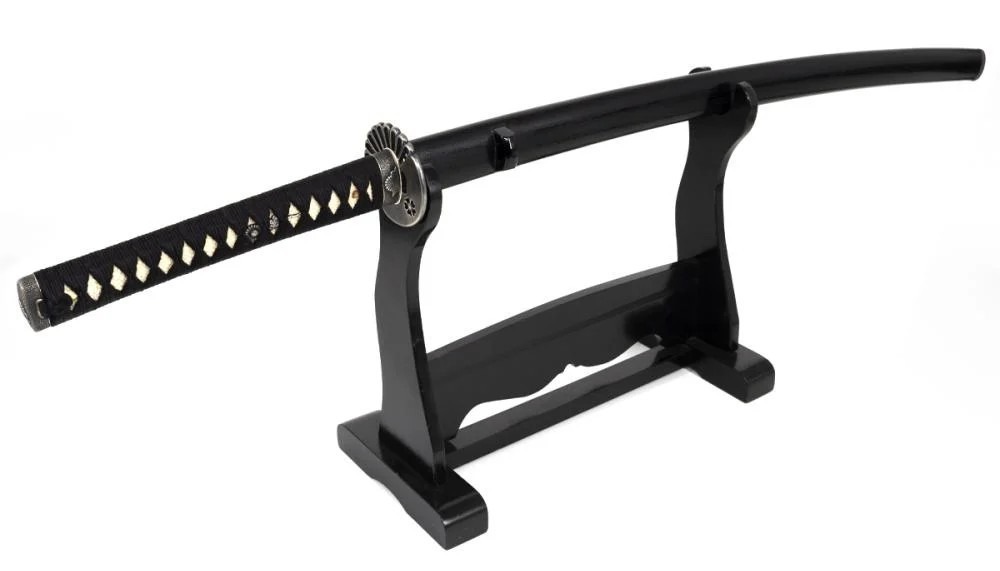
Features:
- Weight: 871g.
- Blade length: 74.3cm (2.45 Shaku).
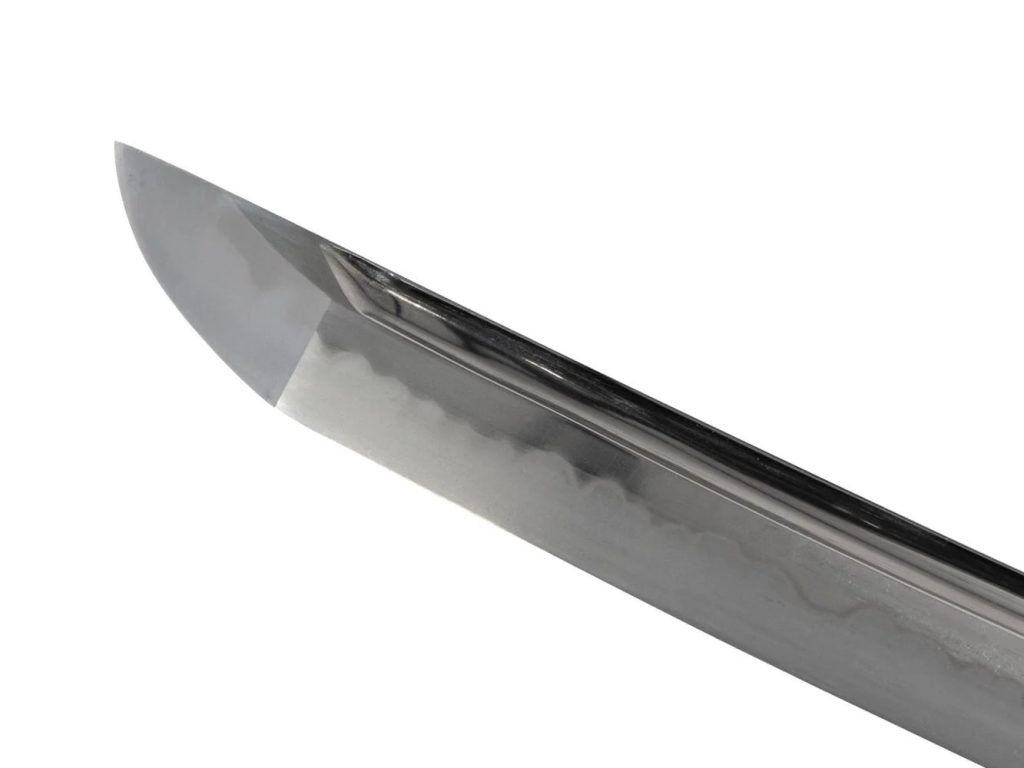
- Hamon: Gnome Midare (Zigzag irregular). Nioi (fine mist).
- Hada: Ko-Itame hada (Tight, fine wood-grain pattern covering the Jigane).
- Ji-nie & Chikei: Fine sparkling crystals and dark activity lines in the grain (Due to unique, local river sand Tamahagane).
- Polish style: Hadori (Cosmetic finishing technique).
- Mune: Iori-mune (Peaked ridge spine).
- Sori: 1.7cm (5.6 Bu) Curvature.
- Kissaki: O-Kissaki (Extended tip).
- Bo-Hi: Kaki-Toshi (Groove on both sides, continues along Tang to Jiri – bottom tip).
- Tsuba: Aged silver-plated guard – half Sukashi (Openwork) Chrysanthemum and half Yasurime (Parallel lines) with a single Sukashi Sakura (Openwork Cherry Blossom) and Kozuka-hitsu-ana.
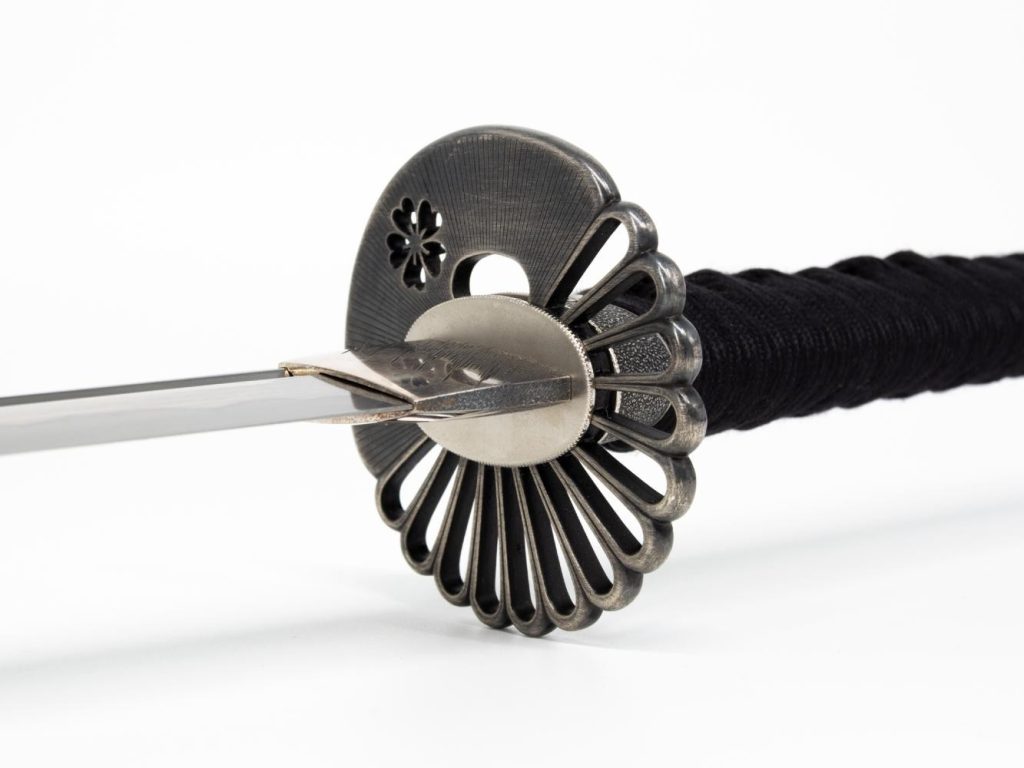
- Habaki: Silver Yujo (Line-brushed pattern) collar.
- Two equal oval shaped silver Kagiri-Seppa (washers).
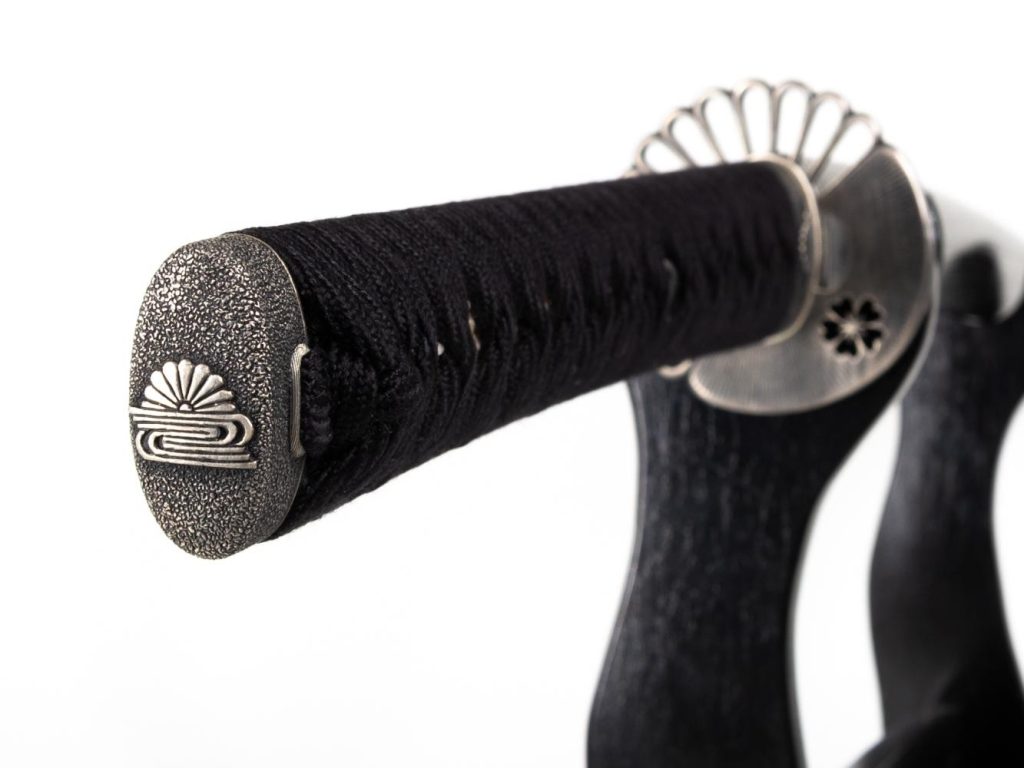
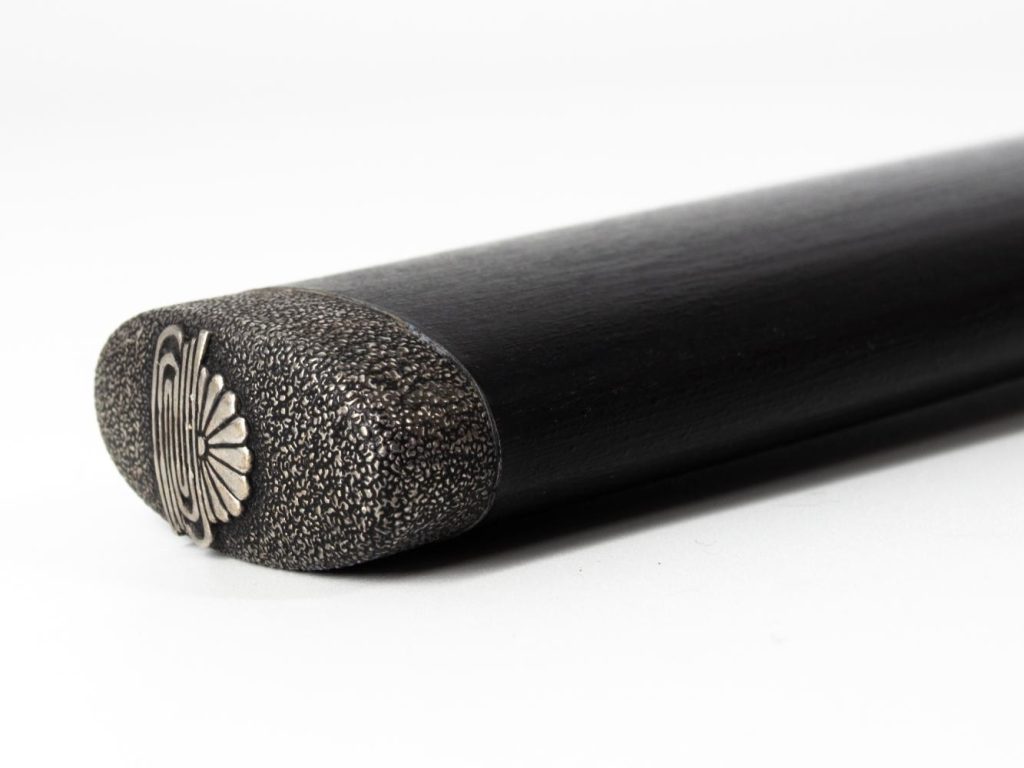
- Koshirae: Silver Kikusui (Flowers floating in running water) themed Fuchi, Nenuki, Kashira and Kojiri fittings.
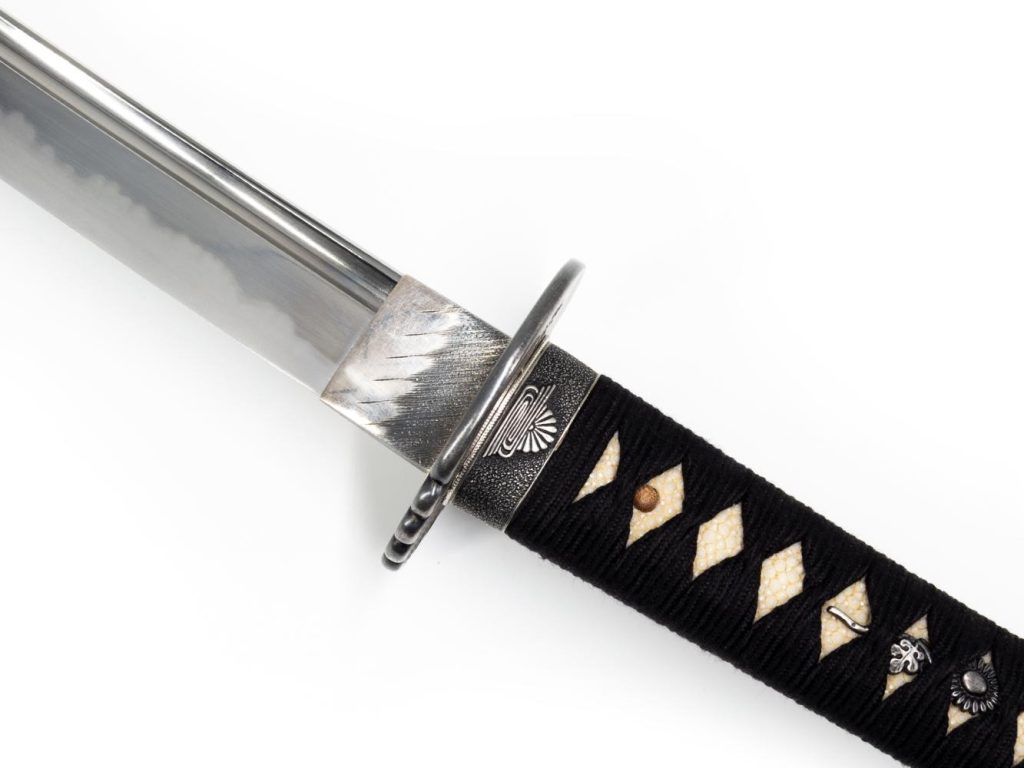
- Tsuka length: 21.6cm (8.5 Sun) Handle.
- Mekugi: One (Bamboo Peg).
- Tsuka Ito: Black Silk cord Hineri-maki (Twisted) style wrap.
- Samegawa: Antique White (Rough Ray Skin) Tsuka grip.
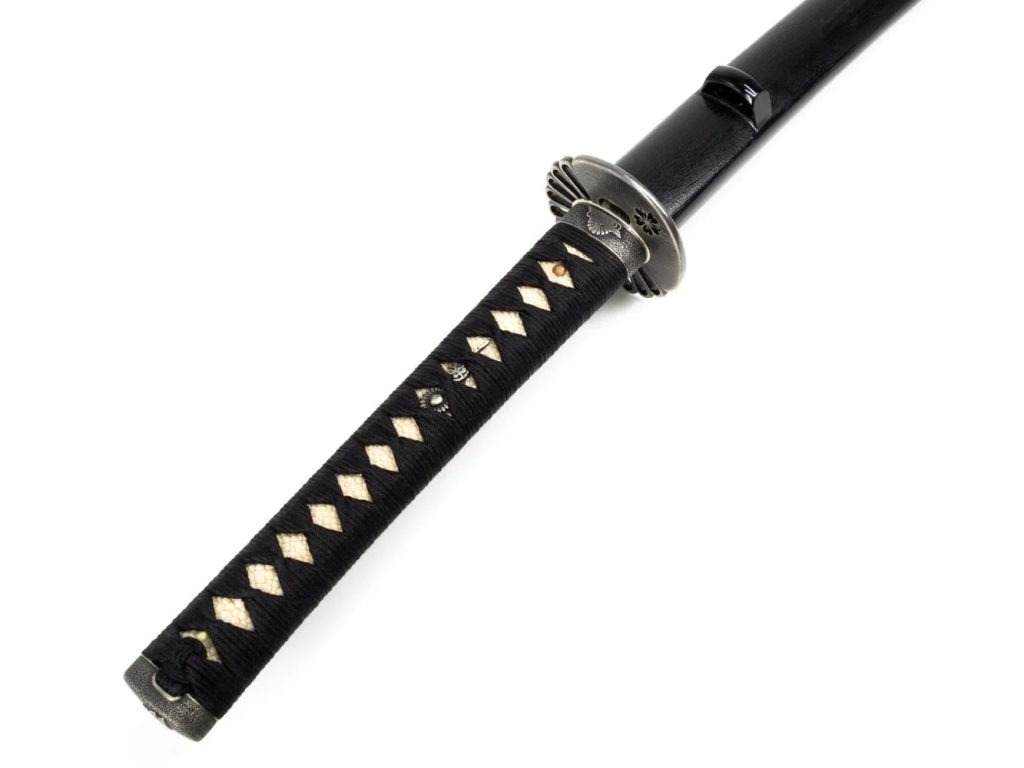
- Saya: Black Hakeme (brush-grain) with Silver Kikusui Kojiri.
- Yasurime (File marks): Sujikai (Steeply slanting diagonal files marks).
- Mekugi-Ana: One (Peg Hole).
- Kurijiri (Chestnut-shaped heel).
- Nakago Shinken Mei (Real Sword Signature Inscription on Tang):
- Omote (Front): Higo no Kuni-ju Akamatsu Taro Kanehiro saku (肥後國住赤松太郎兼裕作) – Made by Akamatsu Taro Kanehiro, resident of Higo Province.
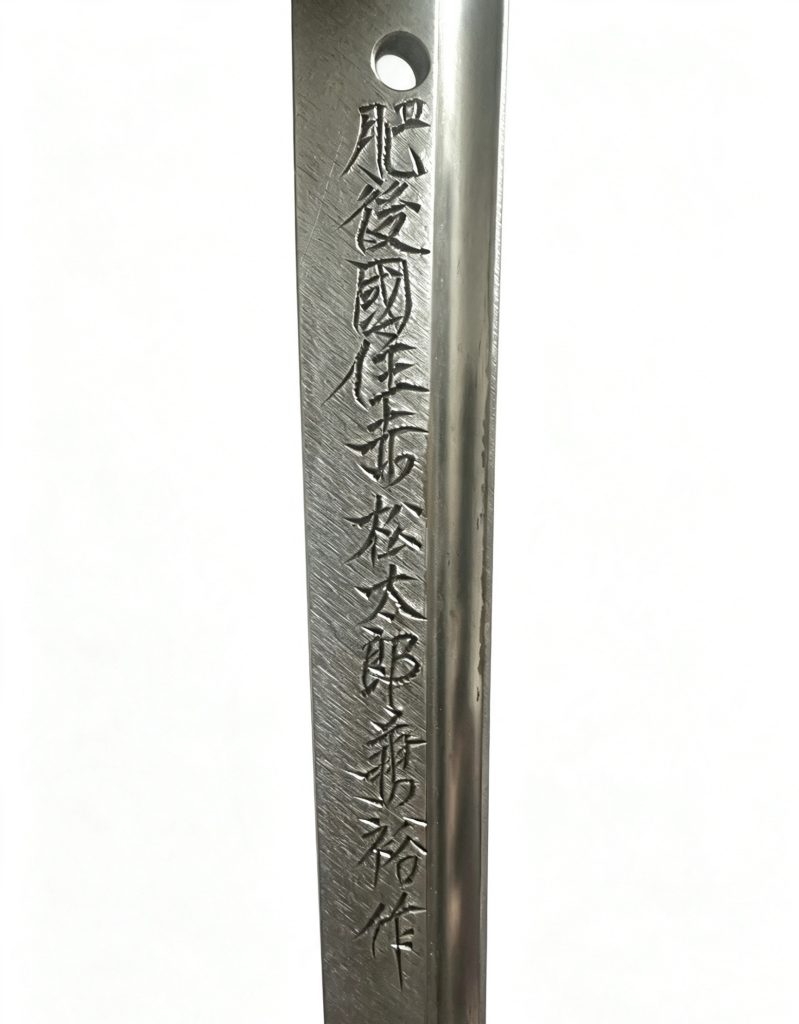
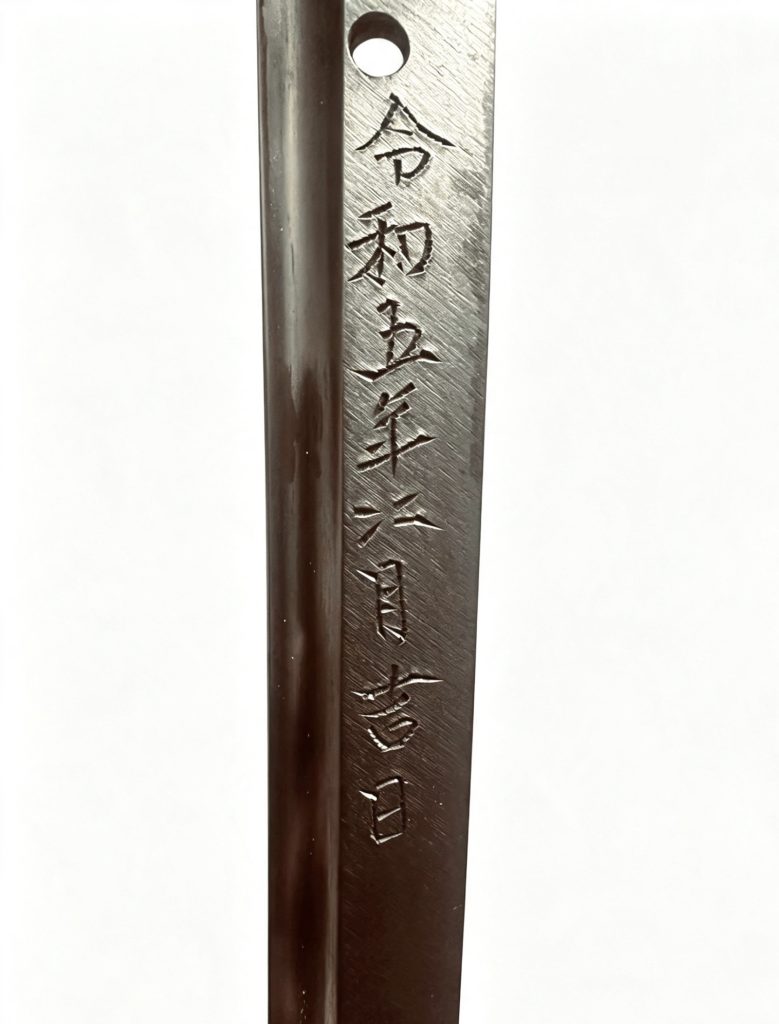
- Nakago MeiBun (Inscription on Tang):
- Ura (Back): Reiwa Go-Nen Roku-Gatsu Kichi-Jitsu (令和五年六月吉日). – A lucky day in June, 2023.
Additional Features:
- Sageo: Deluxe Black Silk Sazanami (Ripple Wave) textured pattern – 8 Shaku.
- Katana-bukuro: Japanese (Kinu-Bukuro) silk lined, Kyoko nishijin brocade sword Bag.
- Ju-Ho-To-Ken-Rui-Torokusho: (Registration Certificate Copy), April 17, 2023
Source:
Shinsakutou from Nosyudo, based in Seki, Gifu — a town with roots as a centre of sword smithing stretching back some 700 years to the Kamakura period. Company president Keiji Igarashi, continuing the work of his father and the company’s founder, Nosyudo works with a network of licensed swordsmiths across Japan, several of them Mukansa-certified — the highest rank a Japanese swordsmith can hold — and many carrying forward names and techniques passed down within their own families across generations.
Each smith works within one or more of the five traditional schools (gokaden) of Japanese sword-making — Bizen-den, Soshu-den, Mino-den, Yamato-den, and Yamashiro-den — each with its own characteristic shape, hamon, and jigane.
Shinsakuto (新作刀) refers to a newly crafted, traditional Japanese sword (nihonto). Forged by licensed, contemporary swordsmiths in Japan, these blades are made using traditional materials (such as Tamahagane steel) and historic techniques. They are highly prized by collectors and martial artists for their flawless condition and customizability.
Because shinsakuto are fully functional, authentic blades, they require strict adherence to Japanese export laws and domestic weapon regulations. Owning a shinsakuto is a popular choice for practitioners of arts like Iaido and Tameshigiri because buyers can custom order the blade’s length, weight, curvature (sori), and aesthetic details.
Background:
Akamatsu Taro Kanehiro , born Kaoru Kanehiro, 1961, is a highly regarded swordsmith working at the Akamatsu-Taro Japanese Swords Studio in Kumamoto Prefecture, Japan.
As a modern maker of authentic nihonto, Kanehiro is dedicated to preserving the centuries-old traditions of Japanese sword smithing while producing blades that meet the highest standards of both craftsmanship and performance.
Every sword is individually forged using traditional methods, reflecting the precision, discipline, and artistry that define the Japanese sword. Working in one of Japan’s historic regions of sword production, Akamatsu Taro Kanehiro combines time-honoured forging techniques with meticulous attention to detail at every stage of the process.
From the careful forging and shaping of the blade to the refinement of its Jihada and Hamon, his work demonstrates a deep respect for the heritage of the Japanese sword while creating pieces that are fully functional and visually striking.
Today, swords forged by Akamatsu Taro Kanehiro are appreciated by martial artists, collectors, and enthusiasts around the world. His blades embody the enduring qualities that have made the nihonto admired for centuries—strength, elegance, and harmony—standing as a testament to the living tradition of Japanese sword making in the modern era.
While mass-produced replicas or unsharpened practice swords exist, a true shinsakuto is classified as a genuine, hand-forged weapon. These swords are completely new and historically “unloaded” (meaning they don’t have an antique history tied to them). Buyers can tailor almost every aspect of the sword, including blade length, curvature (sori), and weight. Hamon (temper line) style and steel grain. Furniture (koshirae) like the tsuba (guard), tsuka-maki (handle wrap), and saya (sheath).
Because the demand for authentic Japanese swords requires specialized licensing and craftsmanship, specialized retailers handle the meticulous process of custom-ordering these from authorized smiths in Japan.
Defining characteristics of the maker’s work:
- The Akamatsu Taro Tradition: Born into a family of swordsmiths, he is the brother of other respected smiths like Akamatsu Taro Kaneteru and Kanetsugu. The family is famous for creating their own unique tamahagane (traditional sword steel), producing a highly distinctive forged steel surface (jitetsu).
- Style & Craftsmanship: Kanehiro is especially known for his interpretations of the late-Edo period master Minamoto Kiyomaro. His blades feature dynamic Bizen style temper lines and Gnome Midare (hamon) and are crafted to be exceptionally wide, sharp, and well-balanced.
- Practicality: Because of their durability and superior cutting performance, his swords are extremely popular among practitioners of iaido (the art of drawing the sword) and tameshigiri (test cutting).
Shinken Mei:
The phrase “shinken mei” combines two distinct Japanese sword terms: shinken (真剣), meaning a live, traditionally forged, and sharpened real sword, and mei (銘), which refers to the inscription or swordsmith’s signature engraved on the sword’s tang (nakago).
Together, the terms refer to the authentic signature or inscription found on a real, live-blade Japanese katana. Signature: His blades are typically signed Higo no Kuni-ju Akamatsu Taro Kanehiro saku (肥後國住赤松太郎兼裕作) – Made by Akamatsu Taro Kanehiro, resident of Higo Province.
Akamatsu Taro Kanehiro (real name Kaoru Kanehiro) is a prominent contemporary Japanese swordsmith from Yatsushiro in Kumamoto Prefecture (historically Higo Province). Operating within the renowned Akamatsu Taro family of swordsmiths, he is highly celebrated for his precise Kiyomaro style reproductions (utsushi) and his practical, battle-ready blades.
Martin Robertson